Herald (Melbourne, Vic.), Saturday 23 December 1933
Odds and Ends Round Melbourne
Victoria's First Astronomical Observatory

THIS Williamstown building, on which stands the time-ball, was Victoria's first astronomical observatory. It was established in 1852. The famous time-ball over the bluestone tower was dropped at precisely 1 p.m. each day, as a check for the chronometers of shipping in the bay. Later it was found that railway traffic and practice gunnery from the Gellibrand battery caused too much vibration for observatory work here.
https://trove.nla.gov.au/newspaper/article/243219099/26385529
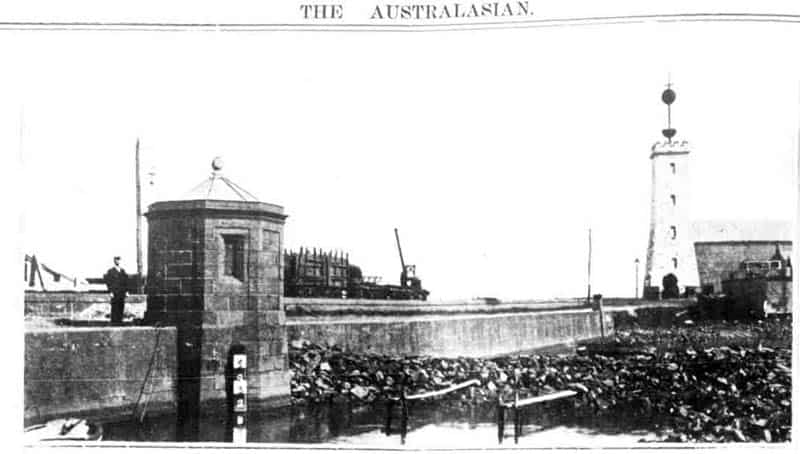
The tower was formerly used for lighting vessels coming up the bay, but it has since been superseded by the Gellibrand lightship, placed about a mile and a half farther down the bay. The time ball is dropped each day at 1 p.m.
TIME-BALL TOWER, GELLIBRAND POINT WILLIAMSTOWN
Herald (Melbourne, Vic.), Wednesday 7 February 1934
OLD TO OUST THE NEW
Romance of Time Ball
REPLACING THE GELLIBRAND
TIME never ceases to bring its revolutionary changes, particularly in the travail of a new island continent like Australia.
But who would have thought that the Williamstown time ball tower would greet 1934 as an important figure for experiments in modern navigation? In years of idleness, the lonely tower has brought unhappy reminders of the prisoners who built it nearly 90 years ago. While modern structures have been blown about by storms, this romantic piece of bluestone has defied the southerlies at their worst, acted as sentry for the wheat boats, and almost shuddered at the shifting of shipping to the other side if the bay.
In the last few days the gloom of the tower has been disturbed by the activity of men with gear for an up-to-date lighting system. The Ports and Harbors Department is making tests which may mean that the almost century-old landmark will replace Gellibrand as the main light of the port.
Curiously enough, it is the rapid construction of modern buildings, with their gay lights, in the city, that has led to the proposal to find a use for the building of settlement days.
In marine courts, recently, ships officers have declared that it is difficult to pick up Gellibrand because of the glare of the colored city lights in the rear.
So it is a case of old lamps for new, because the Time Ball tower was a lighthouse originally. Then the job of guiding ships to port was taken over by Gellibrand. The Time Ball tower was pensioned off with the minor assignment of giving a one o'clock signal every day.
A huge ball, which could be seen from Port Melbourne and other parts of the opposite foreshore, used to be hauled up several feet above the tip of the tower. The apparatus was connected with the Observatory, and the ball dropped daily on the tick of one.
https://trove.nla.gov.au/newspaper/article/243309156/26411932
